

Your most sensitive financial records rarely sit still. They travel across laptops, home offices, and vendor connections every time someone signs in to fix a problem.
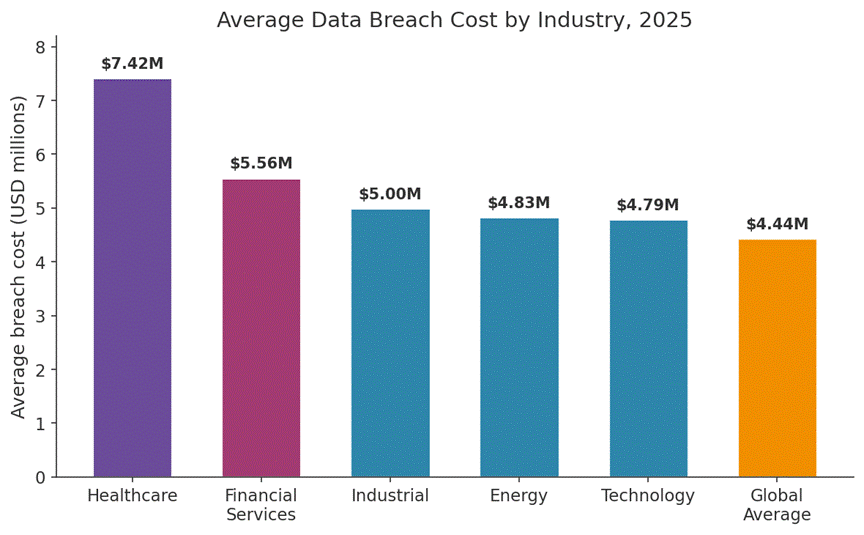
That convenience carries a price. Financial firms absorbed an average breach cost of $5.56 million in 2025, the second highest figure of any industry, according to IBM.
Much of that exposure traces back to how support sessions reach into systems holding account data, trading tools, and client identities.
Closing the gap is not purely a technical job. It is a budget and governance decision, which is why knowing what is remote support technology, and where its risks hide, gives finance leaders and their IT teams a shared place to start.
Key Takeaways
• Financial firms lost about $5.56 million per breach in 2025, trailing only healthcare across all sectors.
• Support sessions can expose account data, credentials, and trading systems whenever access runs without monitoring.
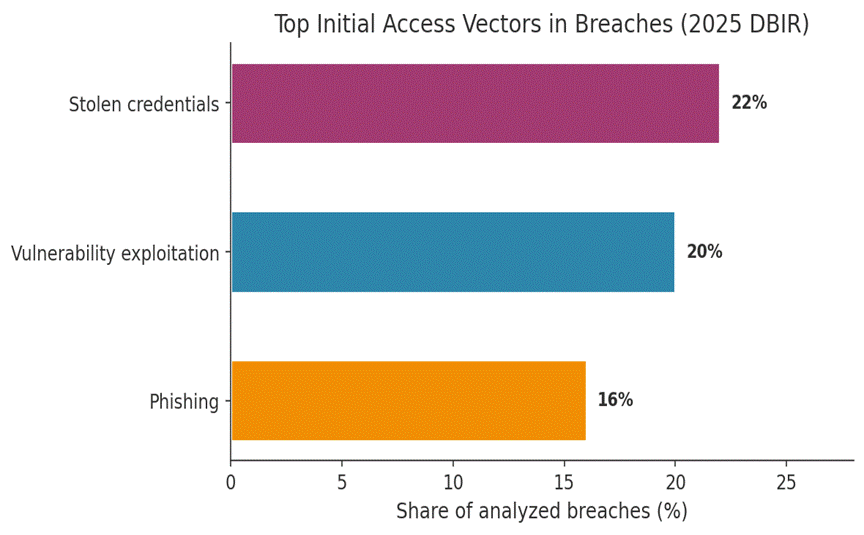
• Stolen credentials opened 22% of breaches last year, so strong authentication is now a baseline, not an upgrade.
• CFOs fund the exposure while IT owns the controls, so their alignment decides how well client data holds up.
• Encryption, multi-factor authentication, session recording, and vendor governance anchor a safer support model.
Why Remote Support Turned Into a Core Finance Risk
Remote support is a controlled method that lets a technician view or operate someone else’s device to resolve an issue, always with permission. In finance, that ordinary helpdesk function now reaches the systems that move money.
Teams depend on it more than most. Advisors work from home, branch staff use mixed hardware, and software vendors log in to patch the platforms behind daily transactions.
Each of those sessions touches regulated data. One mishandled connection can reach customer records, payment rails, or reporting tools that auditors expect to stay locked down.
- Pro tip: List every account and vendor able to open a connection into a finance system. If you cannot name them all in five minutes, that gap is your first risk to close.
Pair every support policy with solid endpoint security strategies, because the device on the far end of a session is part of your attack surface.
The Data Risks Hiding Inside Every Support Session
Most remote support risk stays invisible until something breaks. The danger lives in how access is granted, who holds it, and whether anyone is watching.
Standing Access and Unmonitored Sessions
Standing access is the quiet problem. Technician accounts that stay live between jobs give attackers a ready door, while sessions without recording leave nothing for an investigation.
Audit teams cannot review what was never captured. Full session recording turns a disputed action into a clear, reviewable record.
Vendor and Third-Party Connections
Third-party access carries outsized weight in finance. Breaches involving outside partners doubled to 30% of all cases in Verizon’s 2025 breach investigations report, up from 15% a year earlier.
Every managed service provider, software vendor, or contractor that can open a session becomes part of your exposure. A network infrastructure assessment helps map who actually holds that reach.
Credential Abuse and Weak Authentication
Credential abuse remains the most common way in. Stolen logins started 22% of breaches, and 88% of basic web application attacks relied on them, the same report found.
Tools that allow silent entry, shared passwords, or skipped verification give attackers precisely what they are hunting.
What the Numbers Reveal About Financial Data Exposure
Financial services sit near the top of every breach-cost table. The sector’s $5.56 million average in 2025 trailed only healthcare, while the figure across all industries settled at $4.44 million.
United States organizations face the steepest bill of all, with a record $10.22 million average. Regulators, fraud liability, and shaken client trust each magnify the damage when finance data leaks.
Financial firms paid roughly $5.56 million for every breach in 2025, behind only healthcare among every industry tracked.
The exposure keeps widening. Verizon recorded a near eightfold jump in attacks against edge devices and VPNs, the very systems that often carry remote sessions, with barely half of them fully patched. You can review the full methodology in IBM’s annual breach cost research.
Where CFOs and IT Leaders Stop Seeing Eye to Eye
Most remote support gaps are not technical failures. They are alignment failures between the people who fund security and the people who run it.
A CFO weighs cost, liability, and reporting. An IT leader weighs access, patching, and response time. The table below shows where those views split, and where they should meet.
|
Concern |
CFO Lens |
IT & Security Lens |
Shared Goal |
|
Spending |
Control cost, prove value |
Fund tooling and staffing |
Appropriately scaled controls that cut breach odds |
|
Risk visibility |
Wants a clear risk figure |
Tracks logs and alerts |
Reporting both sides can read |
|
Vendor access |
Reviews contracts, liability |
Grants and revokes access |
Least privilege built into every contract |
|
Compliance |
Owns regulatory exposure |
Implements the controls |
Session records ready for audit |
|
Incident response |
Faces the financial fallout |
Contains the event |
One plan, rehearsed by both teams |
Misalignment tends to surface later as outages and lost confidence, a pattern explored in this look at website downtime in financial services.
Building a Secure Remote Support Framework Together
A strong remote support framework rests on shared rules, not on one team’s preference. These six controls give finance and IT leaders a common checklist.
1. Encryption everywhere. Require TLS with 256-bit AES so session data stays unreadable in transit.
2. Multi-factor authentication. Verify every technician and user before a session opens, with no carve-outs for vendors.
3. Least privilege access. Grant the narrowest reach each task needs, then revoke it when the work ends. This idea sits at the heart of zero trust network access.
4. Full session recording. Capture each action for audit, dispute resolution, and regulator review.
5. Device posture checks. Block connections from outdated or jailbroken hardware before they touch finance systems.
6. Vendor governance. Hold partners to the standard you set internally, written into contracts and reviewed often.
- Security checklist: Before approving any support tool, confirm it offers encrypted sessions, enforced MFA, complete recording, device authentication, and instant access revocation. If a vendor cannot answer those five points clearly, keep looking.
These safeguards work best when they are built into the platforms themselves, a principle covered in this piece on software in financial services.
This short IBM explainer shows how identity, device, and context checks decide every access request, which is the same logic a secure support model should follow.
Frequently Asked Questions
Is remote support safe for financial data?
Yes, when it is configured correctly. Safe setups use encrypted sessions, mandatory multi-factor authentication, recorded activity, and device checks. Avoid any tool that permits silent, unlogged access, because that strips away the accountability auditors and regulators expect from financial firms.
What is the biggest remote support risk for finance teams?
Unmonitored standing access. Technician accounts left active between jobs, combined with sessions that are never recorded, hand attackers a quiet entry point and leave investigators with no reliable trail to follow once an incident surfaces.
How can CFOs measure remote support risk?
Track a few clear signals: the count of active vendor connections, the share of sessions recorded, authentication coverage, and the patch status of access tools. Those metrics turn technical exposure into figures a finance leader can act on.
Do vendors need the same controls as employees?
Yes, often stricter ones. Outside partners caused 30% of breaches in recent Verizon findings. Apply least privilege, time-limited access, and complete logging to every partner, then write those requirements straight into service contracts.
Does zero trust replace remote support tools?
No. Zero trust is a model, not a product. It shapes how your support tools grant access, verifying identity, device health, and context on every request instead of trusting a user once they sit inside the network.
Bringing Finance and IT to the Same Table
Remote support is no longer a back-office convenience. It is a direct line into the systems that hold client money, which makes it a shared responsibility.
When finance and technology leaders agree on the controls, the budget, and the reporting, financial data stops depending on luck. The firms that treat support security as a joint discipline will be the ones still standing after the next attempt to slip through a forgotten session.
More Stories
How Lenders Turn Raw Transaction Data Into Decision Rules
What Documents May Help You Qualify for Lower-Cost Bail?
CraigScott Capital.com: What It Is, How It Works, And What Investors Should Know In 2026