
Artificial intelligence has moved to the center of modern cyber defense, and for good reason. Attacks now arrive faster and in greater volume than any human team can track by hand, while global cybercrime costs are projected to reach 10.5 trillion dollars a year. In response, security tools have grown smarter, learning to spot trouble on their own rather than waiting for a person to notice. The term gets used loosely, though, so it helps to understand what the technology really is and how it works beneath the marketing. This guide breaks down the core idea, walks through the process step by step, and shows where AI fits, and where people still matter, in a modern defense. None of it is magic; the value comes from applying familiar machine-learning ideas to the specific problem of catching attacks.
Key Takeaways
- AI-driven security applies machine learning to catch and stop threats faster than rule-based tools.
- It works in a loop: ingest data, learn what is normal, flag anomalies, respond, and keep learning.
- Core techniques include supervised and unsupervised learning, behavioral analytics, and language processing.
- It excels at speed and volume but still needs human judgment for context and novel situations.
- Adoption is near universal: about half of organizations already use it, and nearly all plan to.
What the Term Actually Means
At its simplest, this is the practice of applying machine learning to defend systems, networks, and data. Traditional tools match activity against a fixed list of known threats. An AI-driven system instead learns what normal behavior looks like and flags anything that strays from it, which lets it catch attacks no one has seen before. Understanding how AI powered cyber security works begins with that shift from fixed rules to learned behavior. The distinction matters because attackers constantly change their methods. A list of known bad signatures is always one step behind, whereas a system that models normal behavior can notice something wrong even the first time it happens. That single capability is much of what makes the approach so powerful, and it keeps the system relevant as attacks evolve.
It is no longer a niche experiment. Across industries, adoption has become the default rather than the exception.
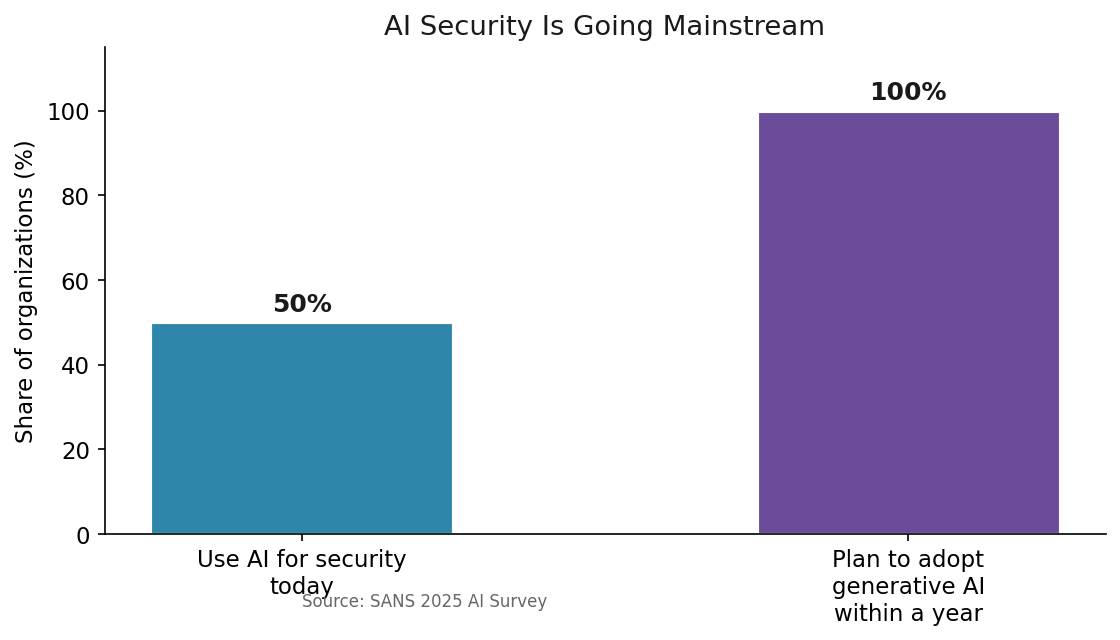
Current use is widespread, and near-term plans are almost universal.
Inside the Loop, Step by Step
Under the hood, an AI security system runs a continuous loop. First it ingests data from across the environment, including network traffic, system logs, and endpoint activity. Then it builds a baseline of normal behavior. From there it watches for deviations, flags the ones that look risky, and either alerts a person or acts on its own. Finally, it folds each outcome back into its models so it sharpens over time.
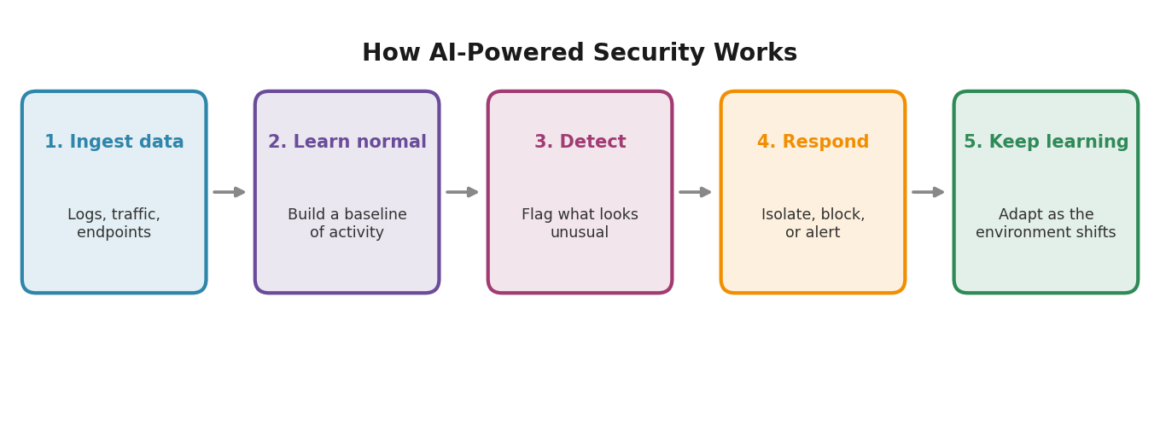
The same loop runs continuously, getting more accurate with every cycle.
This is the same principle behind using machine learning to spot unusual patterns in financial transactions, applied to security data. Government teams already run it at scale: for a real-world example in action, one federal agency uses unsupervised learning to sift terabytes of network traffic daily and surface anomalies for analysts to review. The loop matters more than any single step. Because the system feeds results back into itself, it grows more accurate the longer it runs and the more of the environment it sees. A tool that stops learning soon falls behind. Data quality matters just as much: feed the models messy or incomplete information and even the best algorithm will draw shaky conclusions.
The Core Techniques Under the Hood
Several methods work together to make that loop possible. Supervised learning trains on labeled examples of safe and malicious activity. Unsupervised learning needs no labels and instead groups data to expose outliers. Behavioral analytics profiles users and devices, while language processing reads text to catch phishing. Automation ties it together, responding in seconds.
|
Technique |
What it does |
|
Supervised learning |
Learns from labeled good and bad examples |
|
Unsupervised learning |
Finds outliers with no labels needed |
|
Behavioral analytics |
Baselines each user and device, then flags drift |
|
Language processing |
Scans written messages for phishing and scams |
|
Automation |
Responds in seconds, isolating or blocking |
None of this replaces skilled people; it sharpens what they can see and do. In practice, platforms blend several methods at once. A single phishing attempt might be caught by the text analysis, the odd-login signal, and the automated response working together within seconds. That blend is what lets a modern system react in the moment rather than well after the fact.
“The strongest uses of AI in security are the ones that improve visibility and reduce noise.” Oliver Newbury, former CISO, Barclays
What It Does Well, and Where It Needs Help
AI shines at speed and scale. It can watch millions of events at once, spot both known and unknown patterns, and cut through the alert noise that overwhelms human teams. That is why it pairs so well with a proactive approach to security that catches issues early rather than cleaning up after them.
|
What AI does well |
Where people still lead |
|
Sifts millions of events in parallel |
Judges ambiguous, messy context |
|
Works around the clock at machine speed |
Makes strategic decisions |
|
Catches familiar and brand-new patterns |
Handles truly novel situations |
|
Cuts through alert noise |
Explains and owns the final call |
|
Key stat: the payoff is measurable. Organizations that use AI extensively in their defenses save close to 1.9 million dollars per breach and contain incidents about 80 days faster, according to IBM. |
It is not flawless, though. AI can stumble on unfamiliar context, struggle with genuinely new threats, and produce false positives. Its judgments are only as good as the data behind them.
|
Warning: be wary of “AI washing”, where a basic tool simply wears an AI label. If a vendor cannot explain how its system reaches a decision or what data trained it, treat the claim with caution. |
Used with clear eyes, those limits are manageable. The goal is not a hands-off autopilot but a partnership, where the machine handles volume and the people handle meaning. In a well-run setup, that division of labor is what turns raw detection power into dependable protection.
Putting It to Work
AI security delivers most when it sits on solid ground. Fundamentals still matter: strong access controls, a clear patch management policy, and clean, well-governed data give the models something reliable to learn from. As a business grows, keeping stronger controls as operations grow in place keeps that foundation intact.
[Video: “Introduction to AI and Leveraging it in Cybersecurity”: https://www.youtube.com/watch?v=WWva3v9Hhfk]
This short primer introduces how AI fits into everyday security work.
Keep people in the loop as well. Analysts validate what the system flags, investigate the tricky cases, and own the decisions that carry weight. Treated this way, AI becomes part of a layered defense rather than a single point of failure. Each layer covers the others’ blind spots, and the AI simply makes the whole system faster and more watchful. The result is a defense that scales with the threats instead of buckling under them.
|
Pro tip: start small. Point the tool at one high-value system, measure how well it detects and responds, then expand once it has earned your trust. |
Frequently Asked Questions
What is AI-driven security in simple terms?
It is security software that learns normal behavior with machine learning and flags anything unusual, letting it catch threats sooner than fixed, rule-based tools.
How does it actually work?
It runs a loop: it ingests data, learns a baseline of normal activity, detects deviations, responds or alerts a person, and refines its models over time as it sees more. That feedback loop is what separates a genuine AI system from a static rule engine.
What techniques does it use?
Mainly supervised and unsupervised machine learning, behavioral analytics that profile users and devices, language processing for phishing, and automation for fast response.
Can it replace a security team?
No. It handles speed, scale, and repetitive analysis, but people still provide context, handle novel threats, and make high-stakes calls. It supports a team rather than replacing one, and the best results come from the two working together.
What does it need to work well?
Clean, representative data, solid security fundamentals, and human oversight. Poor data or missing basics limit how well any AI system can perform.
The Bottom Line
Stripped of the hype, AI-powered defense is a straightforward idea: teach a system what normal looks like, let it watch for what is not, and let it act at a speed people cannot match. The mechanics, from data ingestion to continuous learning, are what make it effective against fast, modern attacks. It is not a substitute for skilled staff or strong basics, but a force multiplier for both. Grasping how it operates is the first step to using it well, and to telling genuine capability apart from a clever label. For any organization weighing the option, that understanding is worth more than any vendor pitch.
References
CISA, Artificial Intelligence Use Cases. https://www.cisa.gov/ai/cisa-use-cases
IBM, Cost of a Data Breach Report 2025. https://www.ibm.com/reports/data-breach
NIST, Artificial Intelligence Risk Management Framework (AI RMF 1.0), 2023. https://www.nist.gov/itl/ai-risk-management-framework
World Economic Forum, Global Cybersecurity Outlook 2026. https://www.weforum.org/publications/global-cybersecurity-outlook-2026/
CSO Online, CISOs More Likely to Consider AI-Enabled Security Solutions, 2026. https://www.csoonline.com/article/4120218/73-of-cisos-more-likely-to-consider-ai-enabled-security-solution.html
Fact Check: All statistics and data points in this article were verified against original sources as of July 6, 2026. Sources are listed in the References section.
More Stories
Risk Management Principles Every New Trader Should Understand
Protecting a New Smartphone from Accidental Damage
When Cancel-for-Any-Reason Travel Insurance Is Worth the Extra Cost